Image Courtesy: Pinterest
” Perhaps AI isn’t creating a new fear. It is simply giving an old fear a new name.”
Last Week, Three Conversations Changed My Perspective
Last week, I had coaching conversations with three experienced leaders.
- Different industries.
- Different career paths.
- Different stages of leadership.
Yet somewhere in each conversation, the same theme quietly emerged.
It wasn’t fear of failure.
It wasn’t fear of incompetence.
It was the fear of becoming obsolete.
As the conversations unfolded, they inevitably turned toward Artificial Intelligence.
The rapid pace of technological change.
Jobs being redefined.
Skills becoming outdated.
Stories of restructuring.
Senior professionals wondering whether decades of experience would still matter.
Listening to them, I realized something surprising.
AI wasn’t really the story.
Fear was.
AI had simply become the latest container carrying a fear that has existed for generations.
A decade ago, it was recession.
Before that, globalization.
Then outsourcing.
Then automation.
Then economic uncertainty.
Tomorrow, it will likely be something else.
The names change.
The fear remains.
That realization led me to a deeper question.
Have we unconsciously accepted fear as the default operating system of our professional lives?
We are constantly preparing for the next disruption.
Constantly proving our worth.
Constantly upgrading ourselves.
Constantly running.
As though standing still—even briefly—might make us irrelevant.
And that raises an even bigger question.
Was it ever meant to be this way?
Were our most productive years meant to be spent anxiously trying to stay ahead?
Were we meant to move from one crisis to another, from one scarcity narrative to the next?
Or have we become trapped in something much older than AI?
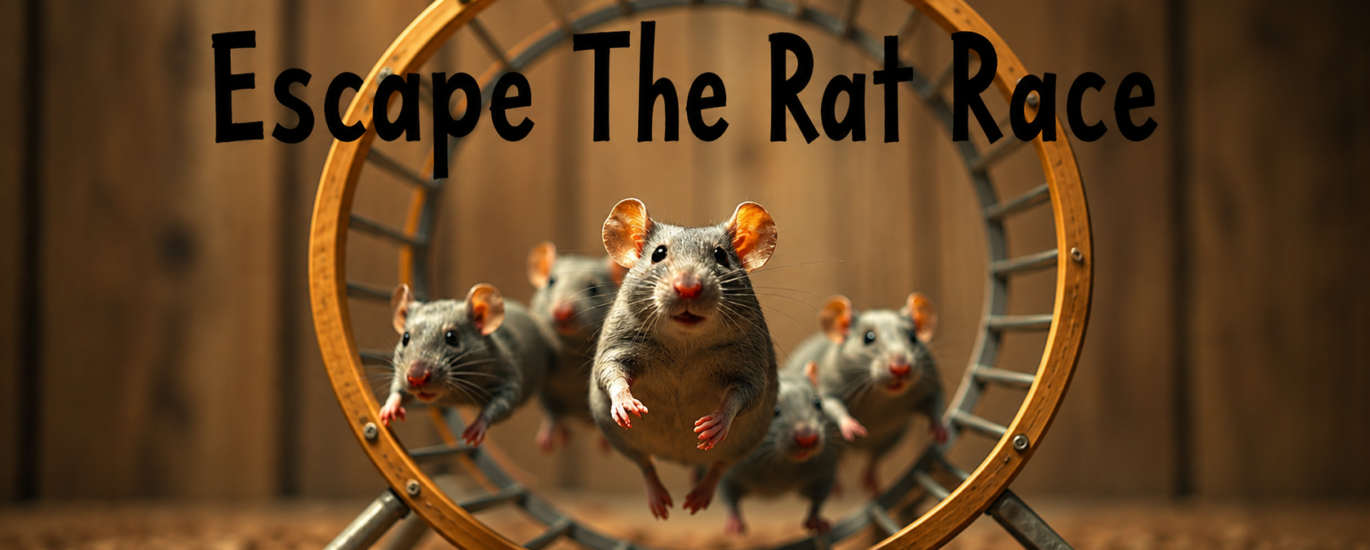
The Rat Race Didn’t Begin with AI
We often speak about AI as though it has suddenly created a culture of insecurity.
But the rat race began long before algorithms entered the workplace.
Its engine has always been fear.
Fear of falling behind.
Fear of missing opportunities.
Fear of losing status.
Fear of not earning enough.
Fear of becoming replaceable.
Technology simply changes the storyline.
The emotional experience remains remarkably consistent.
Many of us spend years preparing for futures that may never arrive while postponing the life we actually want to live.
Without noticing it, survival becomes our identity.
Why Our Brains Keep Choosing Fear
From an evolutionary perspective, this makes perfect sense.
Human beings survived because our brains became exceptionally good at detecting threats.
Psychologists refer to this as the Negativity Bias—our tendency to notice, remember, and react more strongly to potential dangers than positive possibilities.
Thousands of years ago, this helped our ancestors stay alive.
Today, that same mechanism causes our attention to gravitate toward:
- Layoff announcements
- AI disruption
- Economic uncertainty
- Market crashes
- Predictions about disappearing jobs
- Headlines about what could go wrong
The brain treats uncertainty as danger.
The problem begins when temporary threats become permanent mental habits.
Instead of asking:
- What do I truly want?
- What kind of work energizes me?
- What kind of life am I creating?
we begin asking:
- What if I lose?
- What if I’m left behind?
- What if I’m not enough?
Those questions quietly shape our decisions.
Over time, they also shape our identity.
When Fear Becomes the Default Operating System
Fear is useful when it protects us.
It becomes harmful when it starts managing every decision we make.
Many professionals no longer choose careers based on curiosity.
They choose based on perceived safety.
They postpone creative ideas until they feel “secure.”
They remain in roles that drain them because uncertainty feels more dangerous than unhappiness.
Eventually, life becomes an endless cycle of preparation.
Preparing for promotion.
Preparing for recession.
Preparing for AI.
Preparing for retirement.
Preparing.
But rarely living.
The Hidden Cost of the Rat Race
The consequences extend far beyond individual wellbeing.
The World Health Organization estimates that depression and anxiety contribute to approximately 12 billion lost workdays globally every year, costing around US$1 trillion annually in lost productivity.
Yet productivity isn’t the only thing we lose.
We lose curiosity.
We lose creativity.
We lose relationships.
We lose the ability to enjoy achievements because every milestone is immediately replaced by the next source of anxiety.
The issue isn’t hard work.
Human beings are capable of extraordinary effort.
The issue is sustained effort disconnected from meaning.
The Psychology Behind Why We Keep Running
One of the most influential theories in modern psychology—Self-Determination Theory (SDT), developed by Edward Deci and Richard Ryan—offers a powerful explanation.
According to SDT, human flourishing depends on three essential psychological needs:
1. Autonomy
Feeling that our choices are genuinely our own.
2. Competence
Feeling capable, effective, and able to grow.
3. Relatedness
Feeling connected to people and to something larger than ourselves.
When these needs are fulfilled, motivation becomes autonomous.
We work because the work matters.
We learn because we are curious.
We contribute because it aligns with our values.
When these needs are missing, motivation becomes controlled.
We work because we fear consequences.
We seek approval.
We chase external validation.
We keep proving ourselves.
The rat race thrives on controlled motivation.
People keep moving—not because they love the journey—but because stopping feels dangerous.
The result is a familiar paradox:
- Achievement without fulfillment.
- Success without satisfaction.
- Movement without meaning.
Passion Isn’t a Luxury. It’s Psychological Fuel.
Many people believe passion is something to pursue after financial success.
Something reserved for weekends.
Retirement.
Or “one day.”
Psychological research suggests otherwise.
Intrinsic motivation—the desire to engage in work because it feels meaningful, interesting, or personally valuable—is consistently associated with:
- Greater creativity
- Higher engagement
- Better persistence
- Increased wellbeing
- Stronger long-term performance
Passion isn’t simply about happiness.
It is about psychological vitality.
When people regularly engage in work aligned with their values, they often experience what psychologist Mihaly Csikszentmihalyi described as Flow—a state of complete absorption where challenge and capability meet.
Imagine if even 10% of our working week were intentionally devoted to:
- Learning
- Building
- Teaching
- Writing
- Coaching
- Mentoring
- Creating
- Exploring ideas
- Solving meaningful problems
That small shift could dramatically change how work feels.
People rarely burn out because they work hard.
They burn out because they no longer see themselves in what they are building.
AI May Replace Tasks. It Cannot Replace Humanity.
Artificial Intelligence is undeniably transforming work.
Some jobs will disappear.
Others will evolve.
Many new roles will emerge.
The anxiety people feel is understandable.
But perhaps we are asking the wrong question.
Instead of asking,
“Will AI replace me?”
perhaps we should ask,
“What becomes more valuable as technology becomes more capable?”
The answer points toward deeply human strengths.
- Creativity
- Judgment
- Empathy
- Ethical reasoning
- Systems thinking
- Coaching
- Storytelling
- Meaning-making
- Building trust
- Human connection
Ironically, these are often the very qualities people suppress while trying to survive the rat race.
The future may not belong only to those who know the newest tools.
It may belong to those who know how to remain deeply human while using them.
A Different Definition of Success
Perhaps the goal isn’t to escape work.
Nor is it to abandon ambition.
Perhaps the goal is something quieter—and ultimately more sustainable.
To create enough space between survival and striving to hear your own voice again.
To pursue excellence without sacrificing autonomy.
To earn well without living from scarcity.
To keep learning without believing your worth depends on constant proving.
To adapt without allowing fear to become your identity.
Because the most important race was never against your peers.
It was always the journey toward becoming more fully yourself.
And that journey was never meant to be run like a rat.
Reflection
As AI reshapes industries, the real challenge may not be technological adaptation.
It may be a psychological adaptation.
The future will undoubtedly demand new skills.
But it will also demand something even rarer:
The courage to build a life guided by purpose rather than fear.
Perhaps the question isn’t whether you can keep up with the future.
Perhaps the deeper question is:
If fear stopped making your career decisions tomorrow, what kind of work—and what kind of life—would you choose instead?