
Photo by Ashley Batz on Unsplash
We are living through remarkably dynamic times.
Artificial Intelligence is evolving at a pace that is difficult to comprehend. What seemed impossible yesterday is becoming possible today—and what feels cutting-edge today may feel ordinary tomorrow.
Nature, meanwhile, continues to remind us that despite everything we build, predict and control, we are not always the ones calling the shots.
And somewhere between the rise of AI, geopolitical uncertainty, economic volatility and constant technological disruption sits another very human fear:
“Will I still be relevant tomorrow?”
The fear of becoming obsolete can sometimes arrive faster than our morning coffee.
In the middle of all this, I find myself thinking about Maslow’s Hierarchy of Needs.
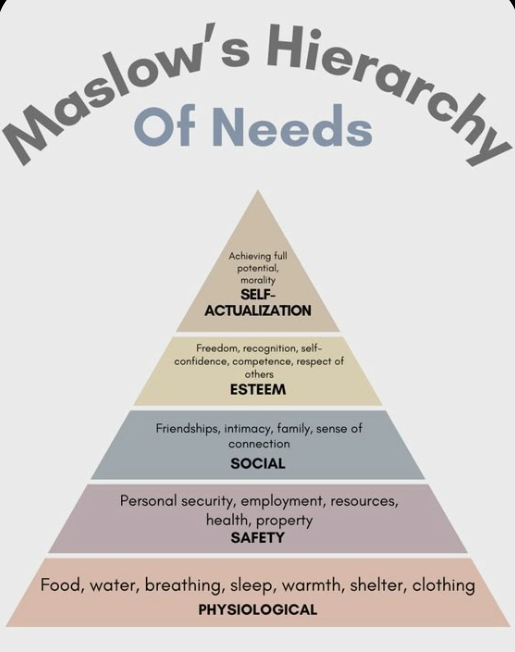
Image Source: Pinterest
Not as a psychological model we learnt years ago, but as a rather useful lens for understanding leadership in uncertain times.
The pyramid may not be as fixed as we think
Maslow’s hierarchy traditionally moves from physiological and safety needs at the bottom, through belonging and esteem, towards self-actualisation at the top.
The idea is simple: as our more fundamental needs are met, we have greater capacity to focus on higher-order needs such as growth, fulfilment and purpose.
But uncertainty has a way of making us move down the pyramid.
A leader who normally operates with confidence, strategic perspective and a strong sense of purpose may suddenly become preoccupied with:
- Will my role still exist?
- Will my skills remain relevant?
- Can I keep up?
- What happens if someone—or something—can do this better than me?
- Do I still have a place in this changing world?
These are not necessarily questions of ambition. They are questions of safety and security. And that distinction matters.
Leadership in an age of uncertainty
We often talk about resilience, adaptability and agility as if they are simply competencies that leaders need to develop.
But perhaps there is something deeper at play. It is difficult to think expansively when you feel threatened.
When leaders feel that their relevance, identity, position or future is under threat, their natural response may be to protect rather than explore.
They may hold on more tightly to what they know. They may become more controlling. They may avoid experimentation. They may seek certainty where none exists.
They may even resist the very changes they intellectually know are necessary. This is particularly interesting in the context of AI.
The conversation is often framed around “How do we make people AI-ready?”
Perhaps the more important question is: “How do we help people feel secure enough to become AI-ready?”
Because learning a new technology is one thing. Reconstructing your sense of professional identity around a changing technology is a difficult ball game.
The leadership challenge: creating safety at the bottom so people can rise to the top
This is where Maslow becomes particularly relevant for leaders.
In uncertain times, leadership is not only about creating a compelling vision of the future.
It is also about creating enough psychological and organisational safety for people to engage with that future.
People need to know:
I can learn.
I can ask questions.
I can admit that I don’t know.
I can experiment.
I can fail without losing my identity.
I can evolve without having to prove that I was never wrong.
When that foundation exists, something changes.
The conversation moves from:
“How do I protect my relevance?”
to
“How can I expand my relevance?”
And perhaps that is the shift leaders need to enable—not just for themselves, but for their teams.
What does this mean for leaders?
Perhaps the leadership challenge today is not to climb Maslow’s pyramid once and assume we have arrived.
It is to recognise that uncertainty can make us move up and down the pyramid repeatedly.
A senior leader facing geopolitical uncertainty may suddenly crave the same sense of security that a young professional feels when AI threatens their role. A highly accomplished executive may experience an unexpected dip in confidence when decades of expertise become less valuable. Someone who has always been the expert may suddenly find themselves in the uncomfortable position of being a beginner again. And that is not failure.
It is being human in a changing world.
The leadership opportunity is to acknowledge this reality rather than pretend that everyone should simply “embrace change.” Because people don’t resist change simply because they are resistant to change. Sometimes they resist because something they deeply value feels threatened.
Perhaps the new leadership question is…
In a world where technology keeps accelerating, geopolitics keeps shifting, and nature keeps reminding us of the limits of our control, perhaps leadership is less about having all the answers.
Perhaps it is about creating the conditions in which people can continue asking better questions.
Can I create enough safety for my people to experiment?
Can I help them separate their identity from a particular skill or role?
Can I make learning feel less like an admission of inadequacy and more like an essential part of staying relevant?
And perhaps, most importantly: Can I do the same for myself?
Because the future may not need leaders who have mastered everything.
It may need leaders who are comfortable saying:
“I don’t know yet. But I am willing to learn.”
Maybe that is what moving towards self-actualisation looks like in an age of AI—not reaching the top of the pyramid, but developing the capacity to keep climbing, even when the pyramid itself keeps shifting.
Coaching can offer a valuable space to slow down, explore what is really driving us and gain clarity about how we want to move forward.